We often talk about finding motivation as if it’s a missing object.
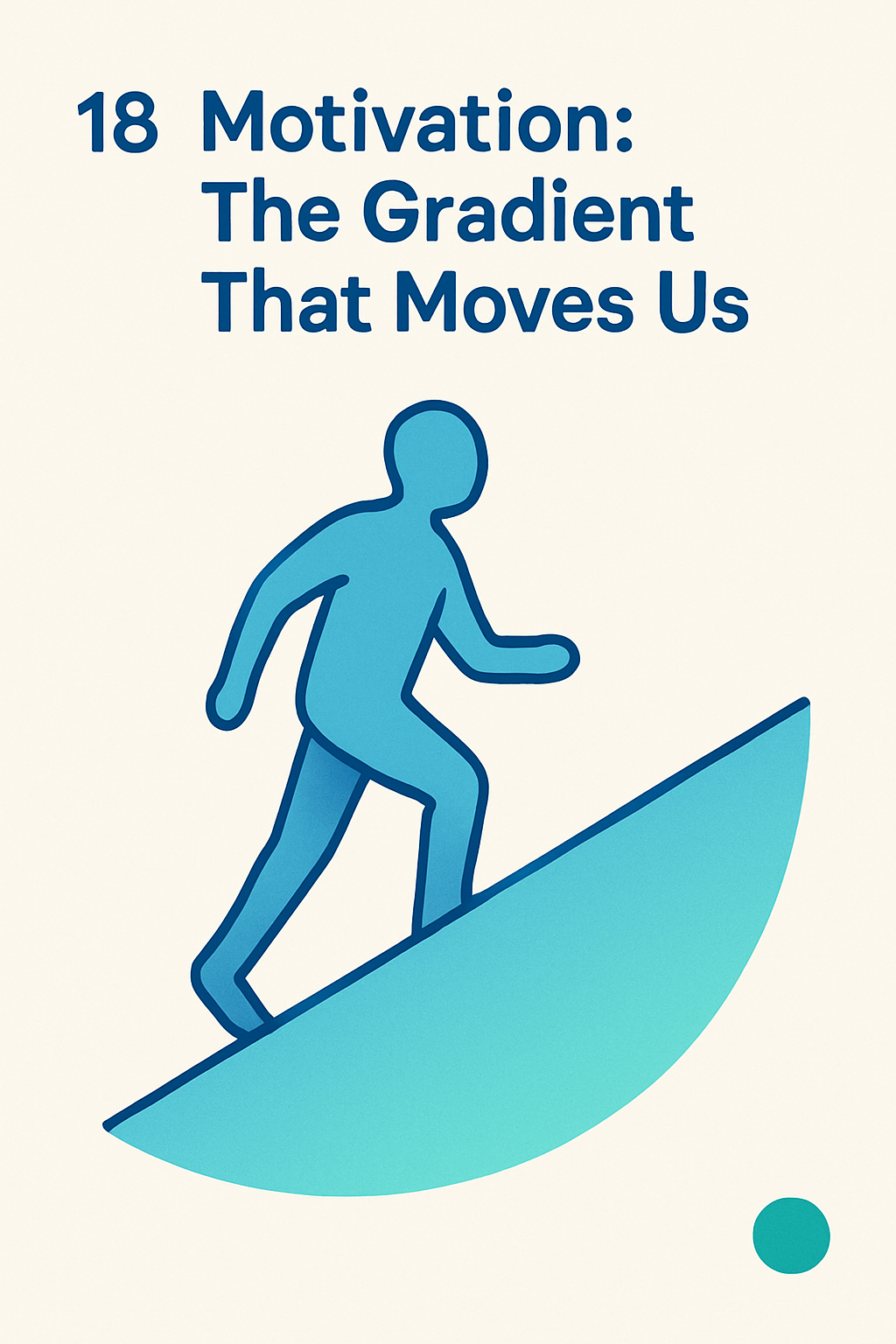
But motivation is not something we locate — it’s something we generate through contrast. It appears wherever there’s a difference between where we are and where we want to be.
In physics, a gradient makes things move: water flows downhill, electricity flows where charge differs.
In psychology, the same principle applies. Movement happens because there’s a difference in emotional potential.
1. The Energy Slope
When life feels flat, motivation seems gone — not because we’re lazy, but because the slope has disappeared.
We’ve equalized the inner landscape: same routines, same thoughts, no emotional difference left to move toward.
To restart flow, we don’t need to push ourselves harder.
We need to create a new gradient — a reason, image, or feeling that raises one side of the hill again.
Ask:
What would make life feel more alive today than yesterday?
Even a small difference — a color, a sound, a goal — can restart the slope.
2. Intrinsic vs. Extrinsic Currents
Extrinsic motivation (rewards, deadlines, approval) acts like external pumps: it pushes movement from the outside.
Intrinsic motivation, however, flows from within the system itself — curiosity, meaning, joy.
External pressure works short term. Internal flow lasts.
But both are forms of energy difference. One is driven by fear or gain, the other by resonance and curiosity.
To find your own gradient, follow what feels alive, interesting, or slightly challenging.
3. Friction and Resistance
Every slope has friction.
Fear, fatigue, or perfectionism can turn the easiest hill into a climb.
Yet friction isn’t the enemy — it’s the element that gives traction. Without it, we’d slide aimlessly.
The trick is balance: enough challenge to move, not enough to burn.
Ask yourself:
Am I resisting because it’s meaningless — or because it’s meaningful and I’m afraid to fail?
4. Recalibrating the Gradient
Motivation fades when:
- We’ve already reached the top and need a new direction.
- The gradient was built on someone else’s desire.
- The friction turned into exhaustion.
Recalibration means redesigning the slope — sometimes lowering the angle, sometimes changing the destination entirely.
Motivation is less about more effort and more about better alignment.
5. The Quiet Gradient
Sometimes, the strongest pull is quiet — not ambition, but attraction.
Not “I must,” but “I want to see what happens.”
That’s the natural flow of energy — curiosity, wonder, connection.
When you align with it, movement feels effortless.
The gradient moves you.
Try this today:
Choose one small action that feels naturally downhill — easy, interesting, alive.
Let it carry you.
Momentum will take care of the rest.
🟢 In other words
Motivation isn’t something we suddenly find; it’s something that changes as our goals and energy change. When we feel unmotivated, it often means our current goals don’t match what matters to us anymore, or we’ve lost direction. To bring motivation back, we can start small — by choosing an action that feels meaningful or slightly challenging. Motivation grows when we feel progress, connection, and purpose. It’s not about forcing ourselves but about adjusting what we aim for and why it matters.